


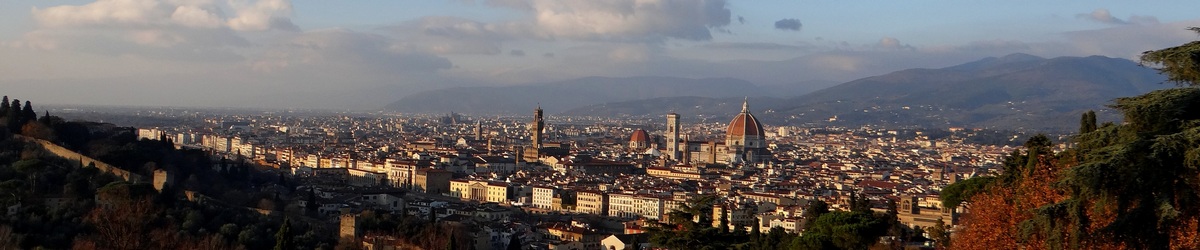
Explorations of an Umbrian city high above the countryside.
Orvieto is located about halfway between the more famous Italian cities of Florence and Rome. The city is located up at the top of a butte with almost vertical sides, leading to an easily fortified city. The butte has been settled since at least the Etruscan period (pre-200 BCE). Orvieto had a lucrative location on a major trading route between Florence and Rome in the Middle Ages. This allowed the city to afford some grand buildings.
 Wandering Jana
 The grandest of those buildings is the Cathedral of Orvieto, built between 1290 and 1591, with some modern alterations. The facade is very similar to the Cathedral of Siena’s.
 Wandering Jana
 The amazing rose window from the 15th century.
 Wandering Jana
 The cathedral started as a Romanesque style building (rounded arches, thick walls, and robust columns), but was later changed to Gothic (pointed arches, lots of large windows) during construction.
 Wandering Jana
 Chapel of the Madonna di San Brizio, a 15th century addition to the cathedral.
 Wandering Jana
 The whole chapel is covered in frescoes.
 Wandering Jana
 The apse is also covered in frescoes.
 Wandering Jana
 Such a gorgeous cathedral.
 Wandering Jana
 Off for a bit of a wander. The street in front of the Cathedral leads to a whole street of handcrafted crafts. Orvieto has some gorgeous ceramics.
 Wandering Jana
 Back to the cathedral and the Papal Palace and the Bishops’ Residence in the rear. Five popes sought refuge in Orvieto in the 13th century. The complex is now home to a few museums.
 Wandering Jana
 In the Diocesan Museum in the old Bishops’ Palace (I think?). I can’t remember what this building was used for but it’s pretty.
 Wandering Jana
 An underground portion of the cathedral. It now serves as a storage area for restoration works.
 Wandering Jana
 Torre del Maurizio has the first mechanical clock of this type documented in Europe. The Maurizio automaton marks the hours by hitting the bell.
 Wandering Jana
 Sant’Andrea and its twelve sided tower.
 Wandering Jana
 The side porch of the church is used for selling flowers.
 Wandering Jana
 Now for the second day of my day and a half visit.
 Wandering Jana
 On the Piazza della Repubblica sits the city hall and previously shown Sant’Andrea (left to the image). The piazza is also home to Sunday morning market.
 Wandering Jana
 Morning sun peeking through.
 Wandering Jana
 The closer I got to the cliff that surrounds the city, the foggier it got.
 Wandering Jana
 A nice walking trail goes almost all the way around the city. There is also an extended version that goes through the countryside. It was a reasonable length but I was not prepared for it. Next time.
 Wandering Jana
 A rock cut church, SS. Crocefisso del Tufo.
 Wandering Jana
 I can see why they built a city here, natural city walls. It’s hard to see in this photo because of the fog but there are man-made walls integrated into the cliffside.
 Wandering Jana
 The stone walls are impressively integrated into the natural rock.
 Wandering Jana
 Fog dissipating in the valley.
 Wandering Jana
 Back up on the butte.
 Wandering Jana
 A typical medieval Italian city.
 Wandering Jana
 Old road up to the city.
 Wandering Jana
 Even the top of the butte isn’t flat.
 Wandering Jana
 The tufa of the butte was very easy to cave out basements, tombs, and wells. This is the Pozzo della Cava. This 6th-5th century BCE Etruscan well was adapted for use again in the 16th century. Then closed a hundred years later and completely forgotten about until it was rediscovered in 1984. It’s 36 meters (118 ft) deep.
 Wandering Jana
 An Etruscan cistern (5th-6th century BCE), complete with ceramic pipes, destroyed to create a new cellar in the Middle Ages for aging wine. The ceramic pipes channeled rainwater into a watertight cistern.
 Wandering Jana
 Such a pretty city.
 Wandering Jana
 I love all the matching roof tiles.
 Wandering Jana
 The Umbrian countryside surrounds Orvieto.
 Wandering Jana
 Palazzo Del Capitano Del Popolo, home to the Captain of the People. No idea what that position pertains.
 Wandering Jana
 City gate on the west side of town.
 Wandering Jana
 Entrance to the Fortezza Albornoz, a medieval fortification.
 Wandering Jana
 The ruins of the Etrurian (Etruscan) Temple of Belvedere.
Orvieto is a gorgeous city not far from Rome or Florence. It’s perfect for a weekend trip. I didn’t go to every museum or attraction there, but there is definitely plenty to see in Orvieto.
Check out my next update where I visit the home of St. Francis of Assisi!
or
Start at the beginning of this adventure.
Share this:

Discover more from Wandering Jana
Subscribe to get the latest posts sent to your email.

